Unions and strikes offshore

Instead of organisations affiliated with the Norwegian Confederation of Trade Unions (LO), company or “yellow” associations were established which then developed into proper unions outside the LO system. These newcomers were not afraid to take on the employers by striking. That made its mark on collective pay settlements for the Norwegian continental shelf (NCS) during the first few decades.
American oil companies, in particular, were anti-union. That was much of the explanation for why the LO failed to win support among offshore personnel from the start.
Many Norwegian oil workers had a background as seafarers. When they got a job on an oil rig or platform, their earnings rose markedly and disposed them to accept the US mindset. The workers saw little reason to join the LO-affiliated Norwegian Seamen’s Union, since it represented seafarers with low pay and poor shift and tour arrangements. Instead, they chose to take new routes.
Inside and outside the LO
A company union on the American model was established in 1973 on the Ekofisk field, which was the first discovery off Norway to come on stream. This was converted relatively quickly into the independent Ekofisk Committee, a union in the traditional sense – except that it was led by a Conservative and remained outside the LO. In order not to stand alone, it forged links with oil workers on the Statfjord and Frigg fields.
The Statfjord Workers Union (SaF) was established in 1976 on the original Ekofisk model – in other words, a company association exclusively for employees of operator Mobil. In the same way, the Elf Aquitaine Norge Offshore Union (Eanof) was founded in May 1977. These three groups joined forces in 1977 through the Collaboration Committee for Operator Unions (OFS), which also remained unaffiliated with the LO. But each of the unions continued to negotiate independently with their respective employers, so that pay and working conditions varied greatly from company to company.[REMOVE]Fotnote: The Ekofisk Committee – an unusual union – Ekofisk (industriminne.no)
The OFS quickly became powerful. It was not afraid to promote demands for higher pay and improved working conditions, and to back them up with strikes. That became a challenge for the operator companies.
These competitor unions were also a problem for the LO. To fight over members and the rules offshore, it set up the Norwegian Oil and Petrochemical Workers Union (Nopef) in 1977. This imposed stronger discipline than the OFS on its members – in line with what industrial workers on land were used to.[REMOVE]Fotnote: NOPEF-nytt no 1, vol 1, May 1978, “Ny lov vil hindre amerikanske tilstander i Nordsjøen?” — Regional State Archives in Stavanger, SAST/A-101609/X/0001.
That these two union organisations both saw the light of day in 1977 was no coincidence. They were partly a response to the adoption of Norway’s Working Environment Act in that year. Under to this legislation, all operator companies were required to work in accordance with Norwegian norms. These included a “tripartite” collaboration between employers and unions (the parties in the labour market) as well as the government.
The Act was extended to the fixed facilities in the North Sea, and had an “educational” effect on both the operator companies and the unions.[REMOVE]Fotnote: Mobile units such as ships and rigs were not covered by the Working Environment Act, but remained subject to maritime legislation. They were therefore less strictly regulated. Ryggvik, Helge and Smith-Solbakken, Marie, 1997, Blod, svette og olje, vol 3, Norsk oljehistorie: 144, 55-58.
Government role in pay talks
Collective pay bargaining in the oil industry as well as the rest of Norway at this time was affected by the particular economic circumstances prevailing in the country. An international slump had followed the first oil crisis in 1973, with Norwegian shipping companies and shipyards forced to restructure extensively after the oil tanker trade crashed.
While Norway was in recession in 1976-78, light could fortunately been seen at the end of the tunnel. North Sea developments meant Labour finance minister Per Kleppe expected the supplier sector to win a lot of work. With the oil industry also likely to yield substantial revenues in the future, Kleppe persuaded the government to adopt a countercyclical policy to surmount the crisis. That required moderate pay demands and strict control of settlements.
The government became heavily involved in negotiations between employers and unions. Instead of pay rises, it offered welfare benefits, tax reliefs and subsidies – known as the Kleppe packages. A pay and price freeze was even imposed in 1978.
At this interface between crisis, caution and future wealth, offshore remuneration created dilemmas. By no means all oil workers were willing to accept strict government pay control. Development projects on the NCS were progressing at high speed, and labour was in big demand. Why should oil workers doing challenging jobs accept a pay freeze? They were surely entitled to their share of the future oil wealth they were helping to create? The workers stuck to their guns and were willing to down tools to achieve their goals. As a result, the most sought-after occupational groups were able to drive up their pay.
Anxious about mainland industries which competed for the same labour, the government viewed this trend with concern. Another question was whether it was “morally” appropriate for offshore personnel to be paid so much more than an industry worker on land. Labour premier Odvar Nordli told Nopef in 1977 that pay developments on the NCS for employees outside the national union organisations – in other words, the OFS – was “one of the biggest problems we face today in the economic system”.[REMOVE]Fotnote: NOPEF-nytt, no 1, 1978.
Although Statoil was not an operator with offshore employees at this time, CEO Arve Johnsen was also worried that pay deals for such workers were out of step with onshore developments. “The main reason was that the same level of tradition and organisational experience which prevailed between the LO and the Norwegian Employers Confederation (NAF) for land-based industry did not yet exist on the NCS,” he wrote in his memoirs.[REMOVE]Fotnote: Johnsen, Arve, 1988, Gjennombrudd og vekst: Statoil-år 1978-1987: 171-174.
OFS flexes its muscles
The OFS secured the status of a national union organisation in 1980, and displayed its readiness for a fight at the first opportunity.
Illegal stoppages on Statfjord in 1981 were the first in a long series. Operator Mobil wanted industrial peace on the field, and fairly quickly made a pay offer which was accepted. The US company’s practice of yielding to demands for more money was a matter of great concern to the Statoil management, since the company was soon to take Mobil’s place as operator. Like Nordli, neither Johnsen nor his other senior executives wanted the oil sector to become the pacesetter for pay settlements.[REMOVE]Fotnote: Ibid; Board document 73/79, Statoil: Statoils uttalelse vedrørende NOU 1979: 30; Samordning av Statens Arbeidsgiverinteresser – Regional state archives in Stavanger, SAST/A-101656/0001/A/Ab/Abb/L0008, XA01A890806-900158.
Once the Statfjord workers had secured a 30-35 raise, their counterparts on Ekofisk and Frigg demanded the same. After several strikes on these fields that autumn, the employers yielded there as well.
LO chair Tor Halvorsen was shocked at what Mobil’s indulgence of the OFS had led to. He described it as “a concrete example of how the parties outside the income policy fellowship could destroy the solidarity [in this area] which has been a cornerstone of the post-war period”.[REMOVE]Fotnote: Meland, Trude, Illegal labour conflicts, Industrial heritage Statfjord. https://statfjord.industriminne.no/en/2019/12/03/illegal-labour-conflicts/
Not all offshore workers agreed with him. A number of members in the seamen’s union were dissatisfied with the results achieved. It had staged a legal strike in early November 1981, but was met with compulsory arbitration. That prompted drillers, roustabouts and rank-and-file seafarers to down tools illegally. This stoppage lasted 11 days without any financial benefits being achieved. During the strike, the union faced a mass walkout by members. A new organisation rooted in the strike committees was founded as the Union of Shipping Company Employees (ROF), which secured more than 1000 members within a few weeks.
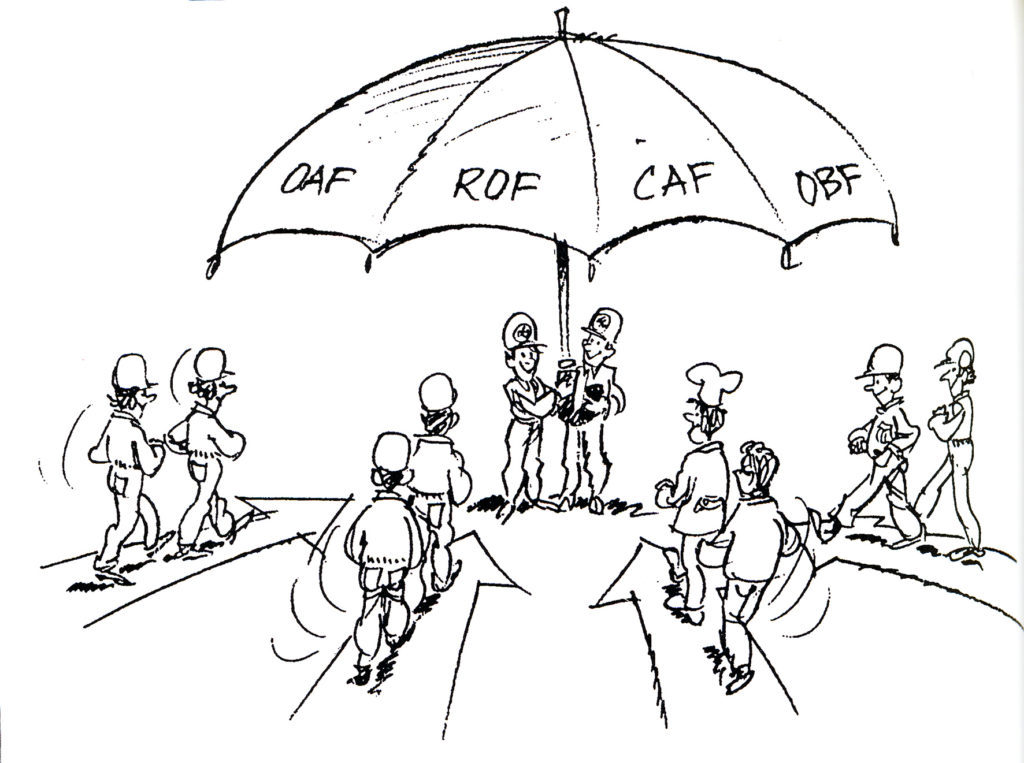
The ROF applied to affiliate with the OFS. So did an independent organisation for drilling personnel which had just been established. Called the Oil Drillers Union (OBF), it organised former Nopef members.
This flood of offshore workers to the OFS prompted a restructuring of the organisation in the spring of 1982 to become the Union of Operator Employees (OAF). That in turn joined with the ROF and the OBF in the Federation of Oil Workers’ Trade Unions (which retained the OFS abbreviation).
The success of the OFS through its willingness to down tools illegally attracted new groups of workers. In March 1983, the Catering Workers Union (CAF) became the fourth affiliated union.
Instead of submitting to the income policy collaboration between the LO, the NAF and the government, the OFS stood forth as an independent body which was a match for the companies and able to pressure them to pay more. The federation was willing to breach the financial parameters set through the income policy collaboration by shutting down all oil production on the NCS. It had thereby become a power player and a risk factor to be reckoned with.[REMOVE]Fotnote: Ryggvik and Smith-Solbakken, op.cit.
Fight-back
As the 1980s progressed, the OFS was involved in a number of stoppages which all ended in compulsory arbitration. In 1986, the catering workers demanded a 30 per cent raise during the pay negotiations. They were angry and disappointed at being paid so much less than other offshore workers. The employers then took the unusual step of imposing a lockout. This was at a time when oil prices were very low, and the government did not intervene since it probably felt that shutting down production would serve its interests by helping to drive prices back up.[REMOVE]Fotnote: Meland, Trude, Strike and lockout, Industrial hertiage Statfjord. https://statfjord.industriminne.no/en/2019/12/03/strike-and-lockout/ So the CAF achieved nothing.
Pay rates were strictly regulated by law in 1988-89, and inflation was moderate. A strike called as a political demonstration in April 1989 was cancelled after Norway’s Industrial Disputes Court found that it to be illegal.
The oil workers were now frustrated and wanted to make up lost ground once free pay bargaining was restored. While the LO still wanted to maintain a policy of moderation, the OFS took a different view and had great expectations of the 1990 settlement. That laid the basis for last illegal strike on the NCS.
arrow_backOffshore employers come togetherQueen’s visitarrow_forward